Monday, September 5, 2011

Early Civilizations

We remember the Neolithic and Paleolithic Times by the idea of "Cave Conjecture". Since writing from early man has not been found, archaeologists have pieced together the lifestyle of early man based on found artifacts. Early man sought shelter in caves (which included a water source), showed a keen understanding of animal anatomy through the detailed paintings in caves such as Lascaux and understood that the role of the female was important to survival of the human species.

As man transitioned from being nomadic hunter gatherers to farmers and herders they established permanent dwellings. With these permanent dwellings, they looked to create communities and establish themselves. Humans became civilized through this process as, within their communities, which they fortified, they developed a division of labor, a written language, a set of laws, established a centralized religion and traded (established commerce).

Civilization began in areas near water. The main early civilized human devleopment is traced in the Ancient Near East along the Tigris and Euphrates Rivers, in Africa (Egypt) along the Nile River, in China along the Yellow River and the Yangtze River valleys and in India in the Indus River Valley.

Many stories have been written about China. The large span of the Chinese Empire mirrors the expansiveness of the Roman Empire. China's customs are different from Western tradition with which many of us are familiar. Perhaps reading a little about China will help you become more familiar with the the large ancient empire and a global power today. for a list of interesting books about China, check out 20 Essential Chinese Novels by Bachelors Degree Online.

Wednesday, August 31, 2011

Why Study Art? TED Talks may have the answer...


Our AP Art History course allows us to study history through the lens of art. It fulfills an high school graduation requirement. You are working toward earning college credit when you take the AP Test in May.

If the information we study is of interest to you, what can you do with it? I am an example of being an Art History major and using it to teach. You can also follow it into becoming a curator, museum director, development director at a museum, museum educator or gallery owner. Additional studies will enhance your ability to get a job. Some Art History majors get legal degrees or law enforcement degrees and seek out and/or prosecute stolen art.

If you enjoy Art and Chemistry you might go into restoration.

If you are interested in Art and Business, you can look into advertising and marketing.

There are many career paths that one may take that involve art, not the creation of art but the understanding of it!

You may wish to check out 20 Amazing TED Talks for Art Majors to get more information about art related careers.

Monday, August 29, 2011

Homework Assignments

Make sure you have signed in to www.turnitin.com. You are supposed to have ACTIVE READ Chapters 1 and 2 for tomorrow and have Chapter 3 completed (reading) for Tuesday 9-6-11.

As you read, you can complete MORE in the workbook than what I assign. Perhaps have it next to you to see what KEY details happen to be. Complete the following sections of the workbook by the dates assigned:

WKBK Ch1 Discussion Question 3...upload to turnitin.com by 11:59 PM 9-1-11.

(HINT: discussion questions are meant to be essays...make sure it STARTS with a thesis and is supported with concrete facts from your reading. No need for flowery introductions...your thesis can be restating the question into a powerful statement you can support).

WKBKCh2DQ3 upload to turnitin.com by 9-2-11 at 11:59 PM


WKBKCh3DQ7 upload to turnitin.com by 9-5-11 at 11:59 PM

WKBKCh3 Looking Carefully upload to turnitin.com by 9-7-11 at 11:59 PM (HINT...answer each prompt...5 total...organize with a thesis to start and a body paragraph for form and composition, another for material and technique, etc.)

Workbook Chapter 1-3: pages due 9-8-11
Page 20 #4
21 #7, #1
22 #4, 6
23 #2
25 #3
31 (definitions)
33 #5,6,7
34 #3
35 #6
The day they are due you will tear out all pages from Chapter 2 and 3, staple and turn them in to the bin in class.

Elements of Art: Color


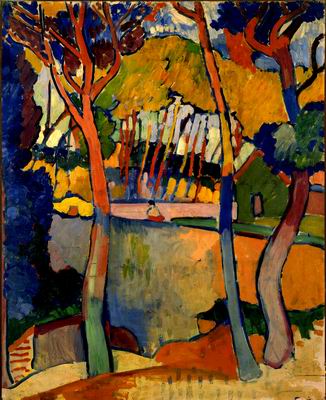
Color is a key element of art as it expresses emotion. A key feature in attracting a viewer is the method by which an artist appeals to the emotion of the audience. An energized scene of bold warm hues of the Fauves (like that of Derain's The Turning Road at L'Estaque, 1906) can excite a viewer while a the calm warm hues of Impressionist work (like Monet's Water Lilies, 1916) can elicit a feeling of serenity.

Colors are key to eliciting not only an emotional but also an intellectual response from the viewer. An artist can cause a viewer to look twice at an artwork by distorting teh colors used. Derain's Three Trees (1906) used unusual colors for natural elements to get viewers to stop and look at nature. The distortion visibly encourages viewers to stop and think about what they see from day to day. When they see nature in an unnatural manner, they start to look at nature again, rather than take it for granted, like wallpaper.

As one moves into the Renaissance and beyond, color psychology is important to consider. Red is considered a power color. How often have you noticed men wearing red ties for important business meetings and Tiger Woods wearing a red shirt for the final round of a tournament? It provides the viewer with subtle hints as to what artists made certain choices in their work. Color sends a message! Follow the link to read more about color theory.

Sunday, August 28, 2011

What is Art?


This is a common question the first week of an Art class. According to Dictionary.com, art is the quality, production, expression, or realm, according to aesthetic principles, of what is beautiful, appealing, or of more than ordinary significance. This definition is ambiguous. According to this definition, one must define what is beautiful and appealing to define art. This definition assumes that what is beautiful and appealing is a universal concept.

Understanding that beautiful and appealing are subjective, one looks deeper into this definition. It states that art is the quality, production, expression, or realm; therefore it implies that art is created, and created according to aesthetic principles. What are these principles? They are the elements and principles of art. That is a topic we can explore another day.

Taking the idea that are is created, one must jump to the conclusion that both mental and physical effort is put forth to create art. Whether one likes the art is a subjective matter, but whether something is art should be clear.

That was not the case in the 1920's when the Romanian artist Constantin Brancusi's The Bird was being brought into the United States. At the time, there was no tariff on artistic imports. When The Bird was being unloaded from the ship, the port authority charged a tariff on the sculpture, saying it was merely scrap metal.

To learn more about the legal proceedings that determined whether Brancusi's sculpture was art or scrap metal, listen to he artist on BBC Radio.

The image that appears here is from the Metropolitan Museum of Art in NYC. This marble Bird in Space is the first of a series of 17 which included 7 marble and 9 bronze views of Bird in Space.

Wednesday, August 24, 2011

Turnitin.com

Thursday in class I'll give you the password to register for turnitin.com for APAH. Purchase your workbooks...Assignments will be due next week.

Turnitin.com will be used for discussions, submitting homework and projects. It is an effort to use less paper and get more immediate feedback on your work.

What's First...Elements and Principles of Art...

Monday, August 22, 2011

Welcome to a New School Year AP Art History Students

Please take the time tonight to bookmark the blog, "follow" the blog and bookmark the AP Art History Class Website.

Your homework is to go through the book and find your two favorite images. One with people and one without. Photograph yourself duplicating the image, as appropriate for school viewing, and send me a digital copy (renemacvay@yahoo.com and rmacvay@sahs.org). Write a paragraph about each image that you liked...two paragraphs total. We'll share in class on MONDAY. HINT: ITALICIZE titles of artworks when you type! Send me the images by Sunday at NOON to the yahoo email account. Bring the paragraphs...typed...to class on Monday

If you wish to read ahead...Read the INTRODUCTION of Volumes 1 and 2 for Friday.
Read Chapter 1 and 2 for Tuesday 8-30-11
Read Chapter 3 for Tuesday 9-6-11

If you have not purchased your workbook from the Turtle Shop, make sure you do it by Friday as you will need it to complete your homework for next week.